What is Eczema?
Eczema is a common skin condition. It can be triggered by many things, including allergens and irritants. Eczema management and treatment can vary from person to person.
At a Glance: Eczema
- Eczema is a group of skin conditions that cause itchy rashes and dry, scaly, inflamed skin. There are seven different types, and atopic dermatitis is the most common. Eczema is not contagious.
- Eczema affects 31.6 million people in the United States. It often starts within the first 5 years of life.
- Eczema happens when the immune system overreacts and the skin barrier is weak. A weak barrier can’t hold in moisture, so skin becomes dry. It also lets in allergens and germs, which can trigger flares. About 70% of people with eczema have a family history of it.
- Common triggers include allergens, harsh soaps, stress, and temperature changes. Triggers are different for everyone. A flare can show up hours after exposure. It helps to track what you were exposed to when symptoms start.
- Eczema can look different depending on skin tone. It appears red on light skin, and darker brown, purple, or ashen gray on dark skin. This can make diagnosis harder for people of color.
- Doctors diagnose eczema through a skin exam and medical history. They may also test for allergies. Tests may include skin prick tests, blood tests, patch tests, or an oral food challenge, depending on what’s suspected.
- There’s no cure, but eczema can be managed. Moisturizers and skin creams are the first step. Treatment options include topical medications, wet wrap therapy, phototherapy, and advanced options like biologics or JAK inhibitors for moderate-to-severe cases.
The skin is the largest organ of the human body. A healthy skin barrier protects us from germs and bacteria. It helps us regulate our body temperature. And it helps us feel things like heat and cold.
Some people live with a chronic skin condition called eczema — a disease that causes itchy rashes and dry, scaly, bumpy, crusty and inflamed skin. It is not a single condition, but rather a grouping of several types of skin conditions, not all of which are related to each other.
Eczema is not contagious.
How Common is Eczema?
Eczema is a skin condition that affects 31.6 million people in the United States.
Atopic dermatitis is the most common type of eczema. Approximately 16.5 million adults and 9.6 million children under the age of 18 have atopic dermatitis.
About 6.6 million people, including 3.2 million children, live with moderate to severe eczema.
Eczema often develops in early childhood. It can start to develop as early as the first 6 months of life.
What Causes Eczema?
The exact cause of eczema remains unknown, but experts believe it may involve:
- Genetics. Approximately 70% of people with eczema report a family history of the condition.
- Immune system sensitivity. An overactive immune response to allergens and irritants.
- Defective skin barrier. A weakened barrier that allows moisture to escape while letting allergens and bacteria in.
Some people with eczema may lack a specific type of protein, called filaggrin, in their skin. This protein serves as a protective barrier from allergens, irritants and infections. When there is not enough filaggrin, it weakens the skin barrier.
Some people with eczema may also have high blood levels of Immunoglobulin E (IgE), which are antibodies produced by the immune system. High levels of IgE can set off allergy symptoms and cause an eczema flare.
When people with eczema are exposed to allergens or irritants, their immune system releases chemicals such as histamines and cytokines (proteins) to fight them off. This process triggers skin inflammation (swelling). It leads to eczema symptoms such as a dry, swollen, itchy rash.
Too much scratching of the itchy rash can thicken the skin. If the skin becomes broken, there is an increased risk of infection. Signs of infection include yellow crusting (often on top of the eczema), swollen bumps or blisters, and pus-filled blisters.
What are the different types of eczema?
There are seven different types of eczema. Each type has its own unique triggers and causes. Treatment options may vary depending on the type of eczema a person has. Let’s look at the different types of eczema.


1. Atopic dermatitis
Atopic dermatitis is a chronic inflammatory skin condition. It is the most common type of eczema. You may often see atopic dermatitis used interchangeably with eczema, even though it is only one type. Atopic dermatitis has a genetic component as it tends to run in families.
With atopic dermatitis, the immune system is easily triggered and sensitive to allergens and irritants. Many people with atopic dermatitis also have a mutation in the filaggrin gene, causing them to have a compromised skin barrier. This, along with inflammation that can damage the skin, allows for moisture to escape and allergens and bacteria to enter the body.
Symptoms may come and go. They include:
- Red, itchy patches of skin on light skin; dark brown, purple or ashen gray on dark skin
- Dry and scaly skin
- Small bumps
- Swelling of the skin (inflammation)
- Areas of thickened skin
- Open, oozing, and crusty sores.
People with atopic dermatitis often also have other allergic conditions such as asthma or allergic rhinitis.
2. Dyshidrotic eczema
Dyshidrotic eczema is another common form of eczema. It causes small, itchy, fluid-filled blisters to form on the hands and feet, often due to an allergic response.
Dyshidrotic eczema tends to run in families. It is seen in people with other types of eczema and is more common in women than men. It rarely appears in children under 10.
3. Contact dermatitis
Contact dermatitis involves skin that becomes irritated when it comes into contact with an allergen or irritant. Unlike most other types of eczema, contact dermatitis does not run in families.
Two subtypes of contact dermatitis: allergic or irritant
- Irritant contact dermatitis – this is the most common type of contact dermatitis. The skin becomes damaged due to contact with an irritant such as a cleaning product (detergent, soap), makeup, or certain metals. It can also occur from the skin rubbing against scratchy clothing.
- Allergic contact dermatitis – the skin becomes damaged due to skin contact with something you are allergic to. This could be something like nickel (found in some jewelry), topical antibiotics, some makeup, or fragrances.
4. Neurodermatitis
Neurodermatitis affects about 12% of the U.S. population. Whereas atopic dermatitis tends to be widespread across the body, neurodermatitis is often confined to one or two patches of skin.
The most common areas affected by neurodermatitis are the arms, shoulders, elbows, legs, ankles, wrists, hands, back of the neck, or scalp.
Neurodermatitis is more common in women than men. Many people report that the itchiness is worse when trying to relax, such as at bedtime, or during periods of high stress.
5. Nummular eczema
People with nummular eczema develop coin-shaped patches of skin that are itchy and may ooze. These areas often develop on arms, legs, hands, or torso. They itch and burn, and fluid may leak out and crust on the skin. The condition is more common in males than females. It can be seen independently from other types of eczema or at the same time.
6. Seborrheic dermatitis
Seborrheic dermatitis is a skin condition most common on the scalp. It also occurs in other areas with lots of oil gland activity. Seborrheic dermatitis is characterized by red, itchy, scaly and greasy patches of skin that produce flaking. It is commonly known as dandruff in adults and teens or cradle cap in infants.
Approximately 11% of the U.S. population has seborrheic dermatitis. It is common in people with certain medical conditions such as adult Hodgkin’s lymphoma, HIV, Down syndrome and Parkinson’s disease.
7. Stasis dermatitis
Stasis dermatitis occurs in people who have poor circulation (venous insufficiency) in their lower legs. It is most common in older adults and women. Common risk factors for developing poor circulation include varicose veins, high blood pressure, obesity and heart failure.
People with stasis dermatitis often have ankle swelling and orange-brown spots when symptoms first emerge. The condition may also cause skin color changes.

What are common symptoms of eczema?
Eczema can come and go, but even when the skin appears clear, there may be inflammation under the skin surface waiting to flare.
Common signs and symptoms of eczema include:
- red rash on light skin; black, purple or ashen gray rashes on darker skin tones
- itchy skin
- dry skin
- bumps and blisters
- flaking
- cracking
- swelling (inflammation)
- crusting
- leathery patches or thickened skin
- open, oozing skin
- sensitive skin
Eczema often appears on the following parts of the body:
- face
- neck
- hands
- wrists
- elbows
- knees
- ankles
- feet
What are the different types of skin changes associated with eczema?
If you open a dermatology textbook, you may be flooded with terms to describe skin conditions and their manifestations. While you may not need to know all the different terms your healthcare provider uses, knowing some of the common ones could help you better understand what is happening with your body.
The following terms describe abnormalities and skin lesions associated with eczema:
- atrophy – a thinning of the upper layers of skin (or dermis). The thinning makes the skin more fragile and prone to tearing. Atrophy is more common as people age, but it also can be caused by use of topical steroid medications.
- erythema – traditionally described as reddening of the skin. However, in people with darker skin pigmentation, symptoms may be less obvious. There may be areas of darker, ashen gray, or purple skin.
- follicular accentuation – inflammation of the hair follicles. This may present as a rash that looks like goosebumps.
- hyperpigmentation – patches of skin that are darker in color than the surrounding skin.
- hypopigmentation – patches of skin that are lighter in color than the surrounding skin.
- lichenification – thickening of skin patches caused by chronic scratching. Lichenified skin may appear red or darker than surrounding skin.
- pruritus – the medical term for itching, a sensation on the skin that makes you want to scratch.
- striae – commonly referred to as “stretch marks.” These may present as indented streaks or streaks of darker or different colored skin. Striae can also result from the use of topical steroid medications.
- telangiectasia – dilated or broken blood vessels on the surface of the skin.
- xerosis – excessively dry skin. This may cause itching, skin flaking, or cracking.
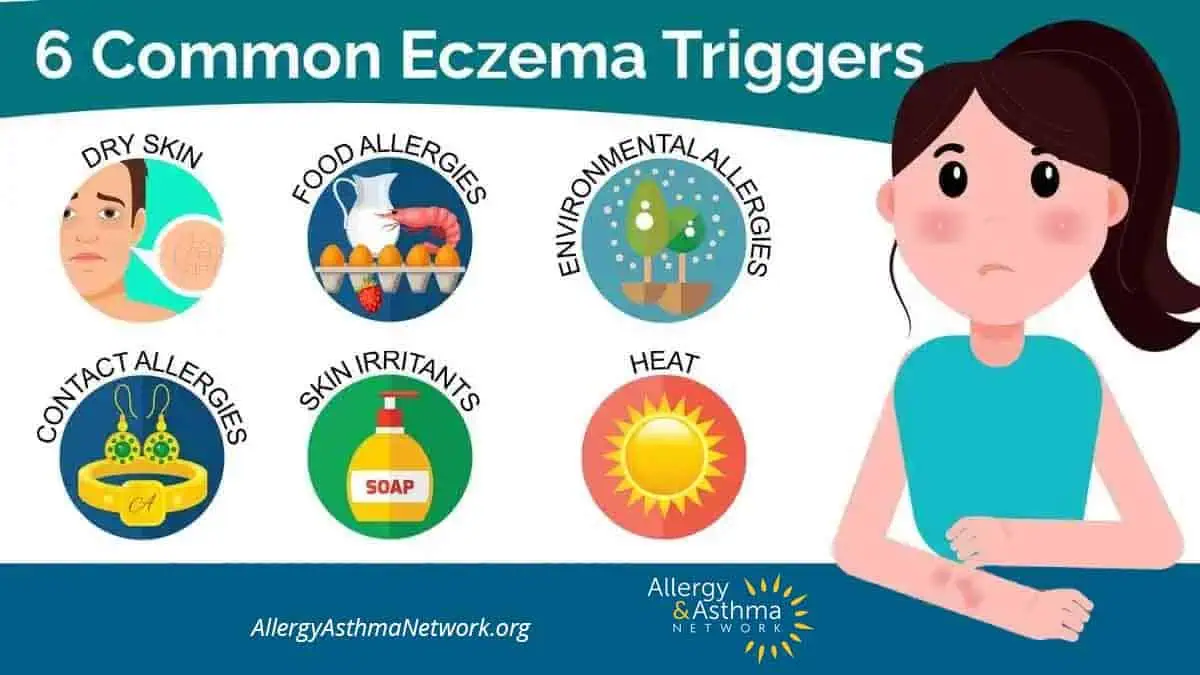
What Are Common Eczema Triggers?
An key part of any eczema care plan is avoiding triggers. These are allergens and irritants that can set off symptoms.
Triggers are different for everyone. What can make identifying them so challenging is sometimes a flare-up can occur hours after the initial exposure. Some people may experience symptoms in certain areas of the body or only at certain times of the year.
Trigger avoidance is essential in managing eczema, but it’s important to remember that, since eczema is a systemic condition, it is not a cure.
Work with your healthcare provider to identify what is triggering your eczema. It may be helpful to keep notes on what you were exposed to when symptoms first emerged.
Here are common eczema triggers:
Contact allergies
Eczema is sometimes set off by something a person comes into contact with regularly. It could be a piece of jewelry that contains nickel, rubber or chemicals used in cosmetics, disinfectants and skin products.
An allergist can do a patch test to identify the specific allergens causing the problem.
Other potential skin irritants include:
- Antibacterial ointments such as neomycin and bacitracin.
- Formaldehyde, which is found in some household cleaning products.
Dry skin
Dry skin can trigger an eczema flare. Many things dry out your skin, like cold weather, low humidity, hot showers or baths, harsh soaps, and frequent hand-washing.
Some people with eczema also lack a protein called filaggrin, which normally helps the skin hold onto moisture. Without enough filaggrin, allergens, irritants and germs can get into the skin more easily.
The best way to prevent an eczema flare is to keep your skin well moisturized. Recent research suggests that moisturizing a baby’s skin from birth may help prevent eczema from developing.
Dust mites
These tiny insects live in mattresses, pillows, upholstered furniture – anywhere they can find moisture. Their favorite food is tiny bits of shed human skin.
Some eczema patients may be allergic to dust mites. Allergens from their droppings or their dead bodies can collect in your bedding, furnishings and house dust. Exposure to these allergens can irritate your skin, airways, and eyes.
When eczema is already flaring, dust mite allergens can worsen the problem.
It’s recommended that you encase your bed’s pillows and mattress with allergen-proof covers. This can help put a barrier between you and dust mites. Wash your linens weekly in hot water and vacuum carpets, floors and furnishings with a HEPA vacuum.
Seasonal or environmental allergies
People with eczema may experience symptoms after exposure to certain grass, tree or ragweed pollen and/or indoor or outdoor mold.
Skin or blood testing for seasonal or environmental allergies will help you identify specific allergens to avoid.
Treatment for symptoms includes daily moisturizing and topical medications if prescribed by your healthcare provider.
Some people with eczema may do well with allergen immunotherapy (allergy shots or tablets). This is when a patient is given a gradually increasing amount of an allergen to build tolerance. This can reduce the risk of developing symptoms when exposed to that allergen in the future. Allergen immunotherapy is available for people with allergies to pollen and mold.
Food allergies
Food allergies can play a role in the onset of eczema symptoms, particularly in infants and young children. It is estimated that between 35% and 65% of young children with moderate-to-severe eczema also have food allergies.
Among children under the age of 2, eczema is most often related to milk or egg allergy, but it can occur with any food. Other common food allergens include peanut, tree nuts, fish, shellfish, soy, wheat and sesame.
Scientists believe the eczema-food allergy connection has to do with the skin barrier. When skin is broken or inflamed due to eczema, tiny bits of food or food protein can get in through the skin. That’s not how the body expects to meet that food. Normally, a person’s gut sees the food first, when its eaten, and that teaches the immune system to accept it. Meeting food through broken skin instead can make the immune system treat it as a threat, leading to development of a food allergy.
Doctors recommend parents introduce foods like peanut and egg to babies starting at 4-6 months of age. This can help lower the risk of developing food allergies. Important: babies who already show signs of eczema at 4-6 months of age should be introduced to these foods only under a doctor’s supervision.
Consult a board-certified allergist or dermatologist for a diagnosis and then develop a plan.
People with food allergies are also at risk for anaphylaxis, a severe allergic reaction. Epinephrine is the first-line treatment for anaphylaxis if you have a severe food allergy.

Pet allergies
Pet dander (dead skin cells), saliva or urine are harmless proteins for most people. For people with eczema, exposure to these proteins can trigger skin symptoms.
For some people managing eczema, it may be best to find a new home for a furry pet. This would reduce pet allergen levels in the home and reduce flare-ups. But if that’s not an option, make sure to bathe your pet at least once a week. Set up no-pet zones, especially the bedroom. Consider using a high-efficiency particulate air (HEPA) filter in the home to help remove pet dander from indoor air.
Hormones
Hormone fluctuations may trigger or make eczema worse for adolescent girls or women. Hormone changes occur just before and during menstruation, during pregnancy, after pregnancy, and when transitioning to menopause.
Outdoor temperatures
Heat can dry out the skin or cause sweating. Sweat, in particular, can collect in your armpits or inner part of your elbow, leading to skin irritation.
Meanwhile, in the winter months, humidity that provides moisture in the air decreases, also resulting in dry skin. A sudden rise or drop in temperature can trigger an eczema flare.
Of course, the weather outside is unavoidable for most people. How can you stay comfortable and prevent eczema symptoms?
Hot weather
- Wear appropriate clothing: light, breathable clothes in the summer.
- Avoid going outside during peak heat, usually between 10 a.m. and 3 p.m. If you do go outside, keep a small towel with you to wipe away excess sweat.
- Stay hydrated to moisturize from the inside out.
Cold weather
Tips to prevent eczema symptoms:
- Wear gloves in the winter (since hands are particularly sensitive and often exposed to cold).
- When indoors, consider using a humidifier to moisturize the air.

Skin irritants (soaps, clothing)
Certain soaps, shampoos, detergents and cleaning products, as well as wool or synthetic clothing, can irritate sensitive skin.
When bathing or washing dirty clothes, use gentle, fragrance-free, non-irritating products. When you find a product that works for your skin, stick with it!
Heavy or tight clothing that rubs against the skin can cause symptoms. Natural fiber clothing, such as cotton or silk, is usually most comfortable. Look for clothes with soft or small seams that won’t rub against the skin. Once an area gets irritated from clothing, it can take a while e for it to calm down.
Stress
Increased stress may cause eczema to flare or worsen symptoms. Some people may scratch more often when they’re feeling pressure.
Managing stress effectively can reduce flares. Coping strategies such as meditation, yoga and regular exercise are great ways to take your mind off your worries. Getting regular sleep is also important for reducing stress. (Sleep can be hard if eczema is flaring, so be sure to follow your treatment plan, especially at night before bed.)
If stress feels hard for you to manage on your own, talk to a mental health specialist, therapist or counselor. Living with a chronic skin condition can affect your mental health, and support is available.
Tobacco smoke
Exposure to cigarette smoke, including secondhand and thirdhand smoke, can irritate the skin (in addition to the lungs). Set a no-smoking policy both inside and outside your home. Smoking is a major health issue for everyone.
Viral and bacterial infections
The common cold and the flu can cause eczema to flare. In addition, the herpes virus — cold sores in and around the mouth — can trigger eczema flare-ups.
Exposure to bacteria can release harmful toxins into the skin, prompting an immune reaction and causing skin swelling. A common bacteria is Staphylococcus aureus, which can not only worsen eczema but also slow skin healing.

Eczema occurs in all races and ethnicities, but it has a unique appearance in people of color. See our partner website for more information ⤑
Eczema occurs in all races and ethnicities, but it has a unique appearance in people of color. See our partner website for more information ⤑
iHow is Eczema Diagnosed?
First, your doctor will examine your skin for symptoms of eczema. Then the doctor will take your medical history, focusing on…
- Personal and family history of eczema, allergies, or asthma symptoms
- Lifestyle factors such as the environment you live or work in, and your stress levels.
- What triggers your eczema or makes it worse — are you using products that cause inflamed, itchy skin, for example?
As part of the diagnosis, you may be asked to undergo testing to find out what allergens and irritants are triggering symptoms. When you know how your eczema occurs, you are one step closer to reducing symptoms, whether it’s through avoidance, medication or other treatments.
Eczema occurs across all races and ethnicities. It can appear differently in people with skin of color. See our partner website for more information: EczemaInSkinofColor.org.

Skin testing
Droplets of suspected allergens are placed on or just under the skin surface. Raised bumps (about the size of a mosquito bite) strongly indicate an allergy to the substance.
Skin testing is commonly used by allergists because of its accuracy, ease of use and immediate results. Results are typically known within 20 minutes.
Blood testing
When a blood sample is drawn, it is analyzed to detect IgE antibodies directed at allergens. Tests may measure specific or overall IgE levels. Some may also break down common allergens and measure IgE to specific components.
Lab results may take several days. Consult with your doctor to ensure the blood test is interpreted correctly. Eczema typically results in very high IgE levels and may falsely elevate results.
Patch testing
Your doctor places small patches on your back. Each patch is held on with sticky tape and contains a tiny amount of a substance that might be causing your eczema. After 2-3 days, the doctor removes the patches and evaluates the skin for reactions.
If symptoms appear, then it’s confirmation of an allergy. Patch testing is commonly used for contact allergies to fragrances, detergents, metal and other chemical substances.
Oral food challenge
If it’s believed that a food is causing eczema symptoms, your doctor may want to perform an oral food challenge. In this test, the patient eats a tiny amount of a suspected allergen, and then gradually larger amounts, to determine whether or when an allergic reaction occurs.
Important: an oral food challenge should only be done by a doctor at a medical facility with access to epinephrine and other emergency treatments.

Other tests helpful in diagnosing eczema
- Buccal swabs, or cheek swabs, are used to detect mutations in the filaggrin gene, the protein that helps protect the body from allergens and bacteria. A lack of filaggrin weakens the skin barrier, reducing skin moisture and leading to eczema.
- Skin biopsies can also be used to measure filaggrin levels, but it is mostly used to rule out other skin diseases, such as psoriasis or cancer. In a biopsy, a tiny piece of skin is removed and then analyzed under a microscope.
After your testing is complete, your doctor will combine your health history, physical exam and test results to reach a diagnosis. Your home and work environments and any activities that might expose you to allergens will all be taken into account as part of the diagnosis.
What is the difference between mild, moderate and severe eczema?
Mild eczema involves small patches of dry, itchy and slightly inflamed skin. It causes minimal or no disruption to activities or sleep. It is usually manageable with moisturizers or over-the-counter treatments.
Moderate eczema involves larger areas of inflamed and itchy skin, often with scaling, thickening, or cracking. It can disrupt sleep or daily tasks and often requires prescription topical treatments.
Severe eczema is widespread inflammation and intense itching, sometimes leading to bleeding or secondary infections. It can make it difficult to sleep and affect concentration, impacting quality of life. Severe eczema usually requires advanced therapies such as biologics, JAK inhibitors, immunosuppressants, or phototherapy.
What Other Conditions Look Like Eczema?
Another challenge in diagnosing eczema is that many other skin conditions appear to be eczema or have similar symptoms to eczema. As a result, people can experience symptoms and not get the right treatment due to misdiagnosis or delayed diagnosis.
These skin conditions may include:
- cutaneous t-cell lymphoma
- Netherton disease
Many of these conditions may resemble eczema or even overlap with eczema. That’s why it is important to work with an allergist or dermatologist for a proper diagnosis and treatment.

What Treatments Are Used for Eczema?
To treat eczema effectively, you should focus on caring for your skin and taking medications as prescribed by your doctor. Eczema therapies are essential to avoiding skin complications and improving quality of life.
Medications and treatments may include:
- moisturizers as a foundation for everyday use
- topical medications, including steroid and non-steroidal creams
- advanced medications for moderate to severe eczema, such as JAK inhibitors (topical and pill) or biologics (injections)
- wet wrap therapy
- phototherapy (light therapy)
Are you concerned about the cost of affording eczema medications?
Check out our
“What if I Can’t Afford My Eczema Medication?”
webpage for information and advice.
How Does Pregnancy Affect Eczema?
Eczema can develop for the first time during pregnancy. But if you had eczema prior to pregnancy, your symptoms may change. Eczema may become more severe, with increased itching, dryness or skin inflammation. However, symptoms do not always get worse. About 1 in 4 women with a history of eczema report their symptoms actually improve during pregnancy.
Why do eczema symptoms vary? Hormonal changes and changes in the immune system during pregnancy can affect people differently.
Talk with your healthcare team about treatment options that are safe for you and your baby. Many medications such as topical corticosteroids are generally safe. Some advanced medications such as biologics and JAK inhibitors may require caution or should be avoided entirely during pregnancy.
How Do I Manage the Challenges of Eczema?
Living with eczema is hard for many people, including caregivers. If you live with eczema, you know that it can greatly affect your quality of life and well-being.
The itching, scratching, sleep loss, and anxiety about physical appearance can impact day-to-day living. It can take an emotional toll on both patients and families.
Although there is no cure for eczema, advanced treatments are available to help manage moderate to severe eczema. Controlling the itch-scratch cycle can also help you cope with eczema and keep symptoms from getting worse. It can also help you sleep at night, a problem for many people with eczema.
Be sure to practice good self-care and seek out the support you need and deserve. Mental healths support is available.
Conditions that can look like eczema
Several skin and immune conditions cause rashes, itching, or swelling that get mistaken for eczema. They differ in what triggers them, how they are diagnosed, and how they are treated. If a rash is not responding to eczema treatment, ask a board-certified allergist or dermatologist whether one of these could be the cause:
- Aquagenic urticaria causes hives after contact with water.
- Celiac disease can cause dermatitis herpetiformis, an intensely itchy blistering rash.
- Chronic spontaneous urticaria (CSU) is hives lasting six weeks or longer with no identifiable trigger.
- Chronic urticaria (hives) causes welts that move around, with individual welts usually fading within 24 hours.
- Cold urticaria brings on hives, swelling, and welts after exposure to cold.
- Contact dermatitis is actually a form of eczema, but it is triggered by an allergen or irritant touching the skin rather than by atopic disease.
- Hereditary angioedema (HAE) causes deep swelling without hives or itching, and does not respond to antihistamines or corticosteroids.
- Mast cell diseases, including mastocytosis and mast cell activation syndrome, can cause unexplained skin rashes along with other body-wide symptoms.
- Primary immunodeficiency diseases include several disorders that produce severe, treatment-resistant eczema-like rashes starting in infancy.
- Psoriasis produces thick, sharply defined, scaly plaques, often on elbows, knees, and scalp.
- Rosacea causes flushing, lasting changes in skin color, and sometimes acne-like bumps on the face, often with burning or stinging.
- Scabies is caused by tiny mites that burrow into the skin, producing a rash with intense itching that often worsens at night.
- Seborrheic dermatitis is a form of eczema that causes flaky, sometimes greasy patches on the scalp, face, and other oily areas of the skin.
October 2026
Reviewed by:
Weily Soong, MD, is a board-certified allergist and immunologist and Chief Medical Officer with Allervie Health (previously Alabama Allergy & Asthma Center). Dr. Soong also serves as Medical Director of the Clinical Research Association of Alabama.
Luz Fonacier, MD is Professor of Medicine at NYU Long Island School of Medicine and is the Head of Allergy and Training Program Director in Allergy and Immunology at NYU Winthrop Hospital. In 2020-21, she served as President of the American College of Allergy, Asthma & Immunology (ACAAI), becoming the fourth woman and first Asian American to serve in that role.