15 Ways to Celebrate Asthma and Allergy Awareness Month
Published: March 30, 2026 Revised: July 1st, 2026
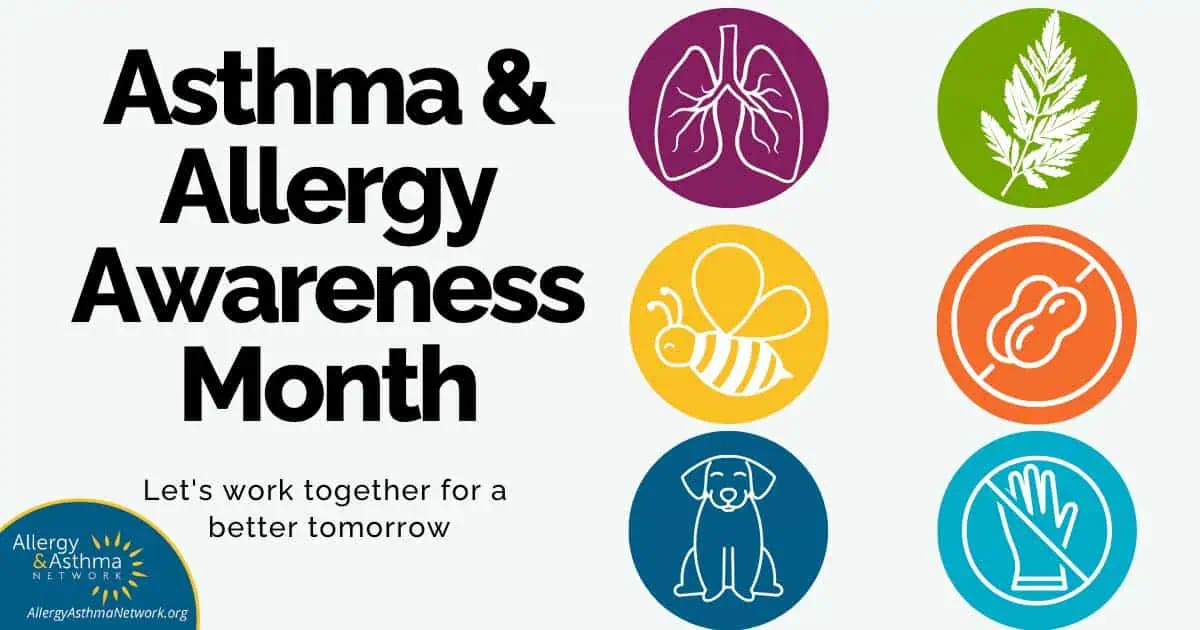
May is National Asthma and Allergy Awareness Month! Join us in raising awareness and taking action to support people living with asthma, allergies, and related conditions.
There’s something everyone can do! Make lifestyle changes to better avoid your asthma triggers. Offer to give a talk at a local community center about asthma and severe allergies. Advocate for patients by sending letters and emails to your representatives in Congress in support of key healthcare legislation.
You can also raise awareness online. Educate family, friends, co-workers and others with just the facts about asthma, allergies and related conditions.
Download our 2026 social media toolkit and share information and graphics across Facebook, Instagram, X, and LinkedIn. Use #AAAM2026 and tag us at @AllergyAsthmaHQ!
Celebrate World Asthma Day on May 5
World Asthma Day is the first Tuesday in May each year. It’s supported by the Global Initiative for Asthma (GINA).
This year’s theme is “Access to anti-inflammatory inhalers for everyone with asthma – still an urgent need.”
The theme aims to encourage people with asthma to use daily controller inhalers, like inhaled corticosteroids. These medications can help keep inflammation in the airways under control.
When possible, GINA recommends using a combination 2-in-1 inhaler that includes both an inhaled corticosteroid and a fast-acting reliever. This approach treats symptoms quickly. It also addresses the underlying inflammation and helps prevent asthma attacks, reducing the need for emergency care.
Advocate on May 6 – Allergy & Asthma Day Capitol Hill (AADCH)
Make your voice heard on critical asthma and allergy legislation and policies by contacting your members of Congress. Our annual advocacy day is May 6, the perfect time to reach out to lawmakers and share your story.
Virtual advocacy takes one minute – and we’ve made it easy for you with ready-to-send emails. This year, our key federal bills include:
- Gio’s Law. The legislation is named after 14-year-old Giovanni Cipriano who died from anaphylaxis. It aims to ensure that first responders have the tools and training necessary to save lives during allergic emergencies.
- Safe Step Act. It aims to protect patients from insurance company practices that delay or deny access to physician-prescribed treatments through “step therapy” or “fail first” protocols.
- EPIPEN Act. The legislation aims to make epinephrine affordable and accessible for all Americans who depend on it in anaphylaxis emergencies.

Share Your Story!
Through the Every Breath Has a Story campaign, we’re inviting you to share your journey with asthma, allergies, or related conditions. Your voice can help others feel seen, understood, and empowered and may even inspire someone to take control of their health.
Whether it’s a challenge you’ve overcome, a daily reality you navigate, or a message you want others to hear, your story has the power to make a difference.
Submit your video and be part of a community turning lived experiences into awareness, connection, and change.
Join the Patient Advocacy Leadership Initiative (PALI)
Changes in federal health policy, funding cuts, and insurance barriers can make it harder and more costly for patients to get needed treatments. Patient voices are needed now more than ever. We invite you to join the new Patient Advocacy Leadership Initiative (PALI).
Participants in the PALI program gain access to training and advocacy opportunities, including:
- Understanding the legislative process and the role of federal and state agencies in healthcare policy.
- Crafting compelling, personal advocacy messages.
- Engaging directly with legislators, staffers and policymakers.
- Navigating key issues affecting access to care, medications, research, environmental health and health equity.
- Building networks with advocacy organizations, community leaders, and other patient champions.
Join us for our monthly webinars to learn more.

Learn about Virtual Asthma Coaching
If you or a loved one is struggling with asthma control, consider our Virtual Asthma Coaching Program. It helps asthma patients get the knowledge and understanding they need from trusted, credible sources.
The coaches are certified asthma educators. They attend health fairs in communities nationwide and conduct asthma assessments and surveys. People with asthma are then invited to enroll in the Virtual Asthma Coaching Program. It’s a free 6-week series of 1-on-1 online meetings, available in English and Spanish.
The coaches work with patients on medications and inhaler technique. They encourage patients to adopt healthy behaviors and make informed decisions about their healthcare. And they help prepare patients for doctor appointments.
Spread the word about the Rules of 2©
Following the Rules of 2 is the best way to identify if your asthma is under control. If you or a loved one has asthma, ask the questions below:
| Rules of Two |
|---|
| Rules of TWO® When is quick relief for asthma NOT ENOUGH? DO YOU….  ✓ Take your quick relief inhaler more than TWO TIMES A WEEK? ✓ Awaken at night with asthma more than TWO TIMES A MONTH? ✓ Do you refill your quick-relief inhaler more than TWO TIMES A YEAR? ✓ Use prednisone TWO or more times a year for flares of asthma? ✓ Measure changes in peak flow with asthma symptoms of more than TWO TIMES 10 (20%)? If you answer “yes” to any of them, talk to your doctor. Rules of Two is a registered trademark of Baylor Health Care System |
Help spread the word about the Rules of 2 with others during Asthma Awareness Month. Keep your eyes and ears open for our Public Service Announcements on TV and radio. This year we partnered with leading allergy and asthma specialists on a series of PSAs promoting asthma control.
Listen and learn!
Tune in to our award-winning Allergy, Asthma & Immunology Innovations podcast, now in its third year. Bring along our podcast for when you’re driving, exercising, or just working around the home.
The 20-30 minute episodes offer insight into asthma and allergic conditions and skin diseases. Learn about asthma, food allergies, eczema, chronic hives, mast cell diseases, biologics, the importance of health equity, and more.
Board-certified allergist Payel Gupta, MD, and asthma, allergy and eczema patient Kortney are co-hosts. They explore topics from the clinician and patient perspective. And they frequently have guests who are experts and specialists in allergy and asthma.

Watch and learn!
Check out our series of video shorts on our YouTube channel! Get quick, easy-to-understand tips on managing asthma and allergies. The videos are perfect for on-the-go learning. We have videos on Navigating Health Insurance, Understanding Type 2 Inflammation, Biologic Medications, and much more!
Or you can attend one of our monthly webinars. Looking for the latest on severe asthma treatments? What about chronic rhinosinusitis with nasal polyps (CRSwNP)? Register now for one of our upcoming expert-led webinars. Webinar recordings are also available to watch on demand.
Go allergy-free for a day!
May 10-16 is Food Allergy Awareness Week. Dedicate one day (or more!) that week to avoiding as many of the Top 9 food allergens as you can. The Top 9 food allergens are: milk, eggs, peanuts, tree nuts, wheat, soy, fish, shellfish and sesame.
Share your allergy-free meal with us on social media. Tag @AllergyAsthmaHQ on most social media platforms.
Get involved in allergy and asthma research
You can help advance asthma and allergy treatments and therapies. When you get involved in research, you help researchers better understand what questions to ask. You can also share important topics and help spread their findings.
Make sure your voice is heard in research studies. Allergy & Asthma Network can connect you with researchers.
- Enroll in a clinical trial or study for new medications and treatments.
- Participate in focus groups.
- Take a survey.
- Participate in a disease registry.
Researchers can also collaborate on their studies with Allergy & Asthma Network.
Support our cause
Millions of Americans face the challenge of living with asthma, allergies and related conditions. Your charitable gift helps ensure they don’t have to go it alone.
We need your support to deliver free patient education programs, advocacy initiatives and research projects.
When you make a donation, your gift makes an impact:
- Patients and families are better prepared to understand and treat asthma and allergies.
- No one, especially the most vulnerable among us, is overlooked and has access to affordable and effective care.
- Support is accessible.
Visit GivetoAAN.org.
Clear the air in your indoor spaces
When people think of air quality, they usually think of the air outside. But the air you breathe in indoor spaces may contain harmful allergens and irritants. And sometimes poor air flow and ventilation allow them to linger. This can trigger asthma and allergy symptoms.
Common indoor allergens and irritants include pollen (coming from outside through open doors and windows); mold; tobacco smoke; pet dander; dust mites, cockroaches and mice; household cleaning products and indoor air fresheners; and respiratory viruses.
Get practical tips on clearing the air in indoor spaces.
Help families with food insecurity
Allergy-friendly foods are increasingly available in grocery stores and supermarkets. But they tend to be more expensive. Allergy-free food products can cost 30% more than non-allergic foods.
Do you know families that are struggling with food insecurity or cannot afford certain allergy-free foods?
You can help by directing families to local food pantries. These are independent community sites that store donated groceries. People can go to the food pantry and pick up the food they need, usually free of charge. Some will stock allergy-free food products or reserve them for people with food allergies.
Get more tips on food insecurity and food allergies.

Teach others how to blow their nose correctly!
The act of blowing your nose may seem simple. But if you do it wrong, it can lead to sinus infections, ear pressure, and worsened asthma and allergy symptoms.
Here are some quick tips to help others blow the right way:
- Gently press one nostril closed and blow softly through the other into a tissue.
- Repeat on the other side.
- Never blow too hard and always wash your hands before and after.
Teaching kids and even adults the proper technique can make a big difference!
Share educational resources
Have you seen our new Infant Anaphylaxis infographic, developed with a leading pediatric food allergy expert? We also updated our popular Respiratory Treatments, Epinephrine Treatments and Latex Allergy posters.
Educate patients, family, friends, co-workers and others with just the facts on allergic diseases! Visit our Online Store to download or purchase educational resources – great for handouts in doctor’s offices and for patients. Many are available in Spanish.
Keep sharing, educating, and advocating all month long – together we can build healthier, more inclusive communities for everyone impacted by asthma and allergies.
Thank you to Amgen, AstraZeneca, Sanofi – Regeneneron for supporting our 2026 Awareness Month efforts!