Eczema Statistics
Eczema is a chronic skin condition. The most common form is atopic dermatitis (AD). Eczema causes a dry, itchy, inflamed and bumpy skin rash that sometimes weeps clear fluid. The condition is not contagious.
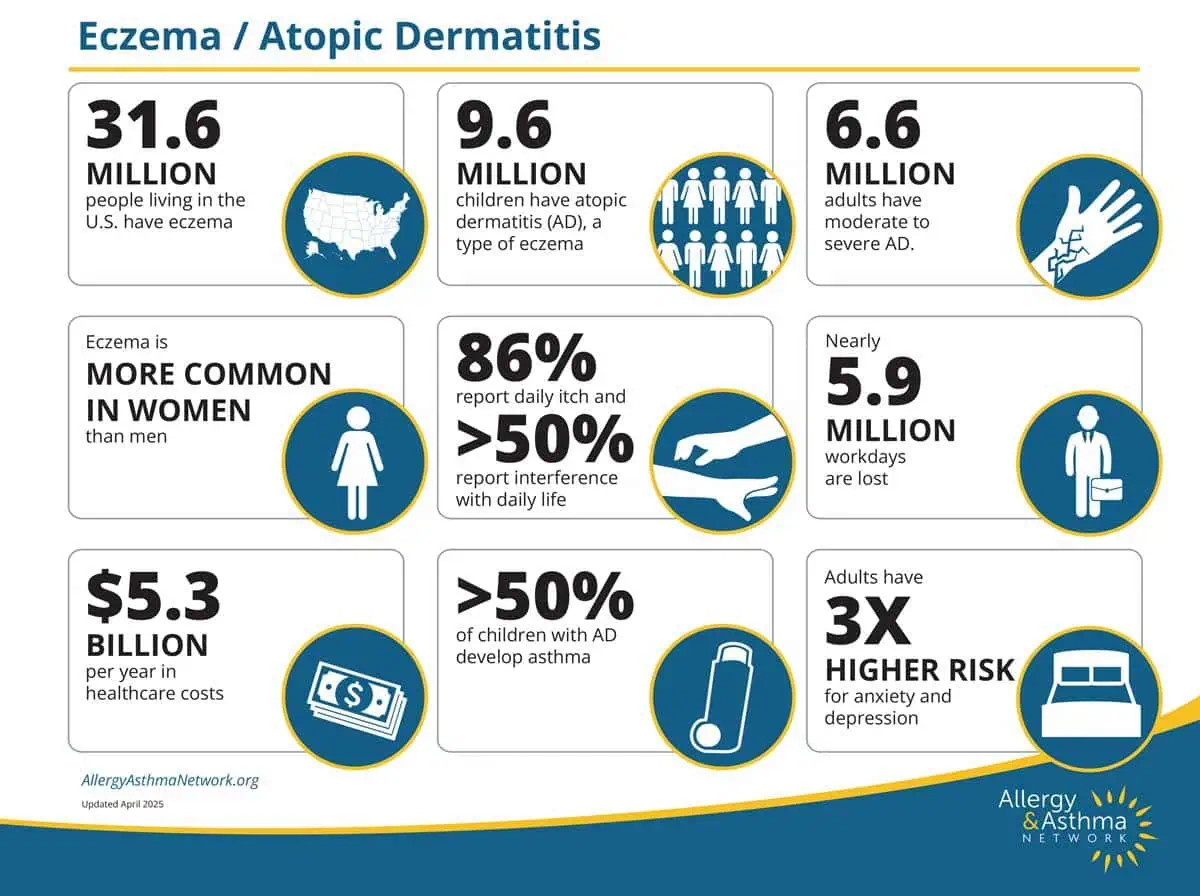
Eczema / Atopic Dermatitis Stats with References
- 31.6 MILLION people living in the U.S. have eczema
- 9.6 MILLION children have atopic dermatitis (AD), a type of eczema
- 6.6 MILLION adults have moderate to severe AD.
- Eczema is MORE COMMON IN WOMEN than men
- 86% report daily itch and >50% report interference with daily
- 5.9 MILLION workdays are lost
- $5.3 BILLION per year in healthcare costs
- 50% of children with AD develop asthma
- Adults have 3X HIGHER RISK for anxiety and depression
Conditions that can look like eczema
Several skin and immune conditions cause rashes, itching, or swelling that get mistaken for eczema. They differ in what triggers them, how they are diagnosed, and how they are treated. If a rash is not responding to eczema treatment, ask a board-certified allergist or dermatologist whether one of these could be the cause:
- Aquagenic urticaria causes hives after contact with water.
- Celiac disease can cause dermatitis herpetiformis, an intensely itchy blistering rash.
- Chronic spontaneous urticaria (CSU) is hives lasting six weeks or longer with no identifiable trigger.
- Chronic urticaria (hives) causes welts that move around, with individual welts usually fading within 24 hours.
- Cold urticaria brings on hives, swelling, and welts after exposure to cold.
- Contact dermatitis is actually a form of eczema, but it is triggered by an allergen or irritant touching the skin rather than by atopic disease.
- Hereditary angioedema (HAE) causes deep swelling without hives or itching, and does not respond to antihistamines or corticosteroids.
- Mast cell diseases, including mastocytosis and mast cell activation syndrome, can cause unexplained skin rashes along with other body-wide symptoms.
- Primary immunodeficiency diseases include several disorders that produce severe, treatment-resistant eczema-like rashes starting in infancy.
- Psoriasis produces thick, sharply defined, scaly plaques, often on elbows, knees, and scalp.
- Rosacea causes flushing, lasting changes in skin color, and sometimes acne-like bumps on the face, often with burning or stinging.
- Scabies is caused by tiny mites that burrow into the skin, producing a rash with intense itching that often worsens at night.
- Seborrheic dermatitis is a form of eczema that causes flaky, sometimes greasy patches on the scalp, face, and other oily areas of the skin.