
Mortality Risk in Patients with Chronic Spontaneous Urticaria
Welcome to the Allergy, Asthma & Immunology Innovations podcast. We introduce a new episode of The Itch Review, in which we highlight key research in allergy and immunology. This episode looks at chronic spontaneous urticaria (CSU), also called chronic hives, and evaluates whether the condition can increase a person’s risk of dying.
Our podcast hosts, Payel Gupta, MD, and Kortney, are joined by Michael Blaiss, MD, to review the article, “Mortality in adult patients with chronic spontaneous urticaria: A real-world cohort study,” published April 2025 in The Journal of Allergy and Clinical Immunology.
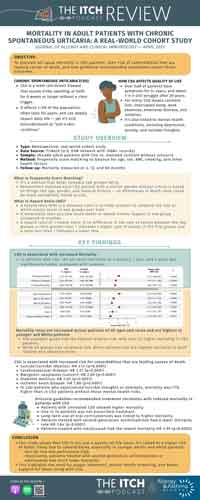
The study asks: Do adults with CSU have a higher risk of death than people without hives? To answer that question, researchers looked at the health records of more than 272,000 adults with CSU and compared them to nearly 13 million people without hives.
You can listen to the podcast on ItchPodcast.com or download it for listening anytime, anywhere, at:
This podcast is for informational purposes only and does not substitute professional medical advice. Any mention of brands is also informational and not an endorsement. Always consult with your healthcare provider for any medical questions or concerns.
Thank you to Novartis for sponsoring this episode.
What we cover in this episode about chronic hives and mortality risk
CSU is not life-threatening, but it can seriously affect daily life and mental health. In this podcast, you will learn what CSU is, what the study looked at, what it found, and why it matters.
- What is CSU? CSU is a condition where red, itchy hives appear on the skin for 6 weeks or longer. It can also cause swelling. These symptoms often come and go without a clear reason.
- How does CSU affect health? CSU doesn’t just affect the skin. It can make people feel anxious, depressed, and tired. Many people with CSU say it lowers their quality of life.
- What did the study do? Researchers looked at health records from over 272,000 people with CSU and compared them to almost 13 million people without hives.
- What did the study find? People with CSU had a higher chance of dying over time, especially from suicide. Younger people and white patients with CSU had the highest risk. Patients who got the right treatments were less likely to die.
- Why does this matter? CSU is more than just itchy skin. It can affect the whole body and mind. Getting the right care may not only improve symptoms, but it could save lives.
Timestamps for our episode on CSU and mortality risk
01:49 – Definition of chronic spontaneous urticaria
03:40 – What the study wanted to find out
04:54 – How the study was done
06:57 – What “propensity score matching” means
09:03 – Who was included in the study
11:05 – What the researchers looked at
12:28 – What the study found
13:19 – People with CSU had a higher chance of dying
17:29 – Death risk by age and race
20:42 – Other health problems linked to death, like suicide
23:00 – What kinds of treatment helped lower the risk
27:56 – Dr. Gupta shares her thoughts
29:47 – Dr. Blaiss shares his thoughts
Resources about chronic hives
- What is Urticaria?
- Chronic Idiopathic Urticaria – also known as chronic spontaneous urticaria
- Chronic Urticaria Management, Resources & Glossary of Terms
- Corticosteroid Exposure and Cumulative Effects in Patients with Eczema: Results from a Patient Survey


