
Understanding the New Childhood Vaccine Guidelines
Published: January 29, 2026 Revised: April 30th, 2026

By Nissa Shaffi, Director of Advocacy, Allergy & Asthma Network
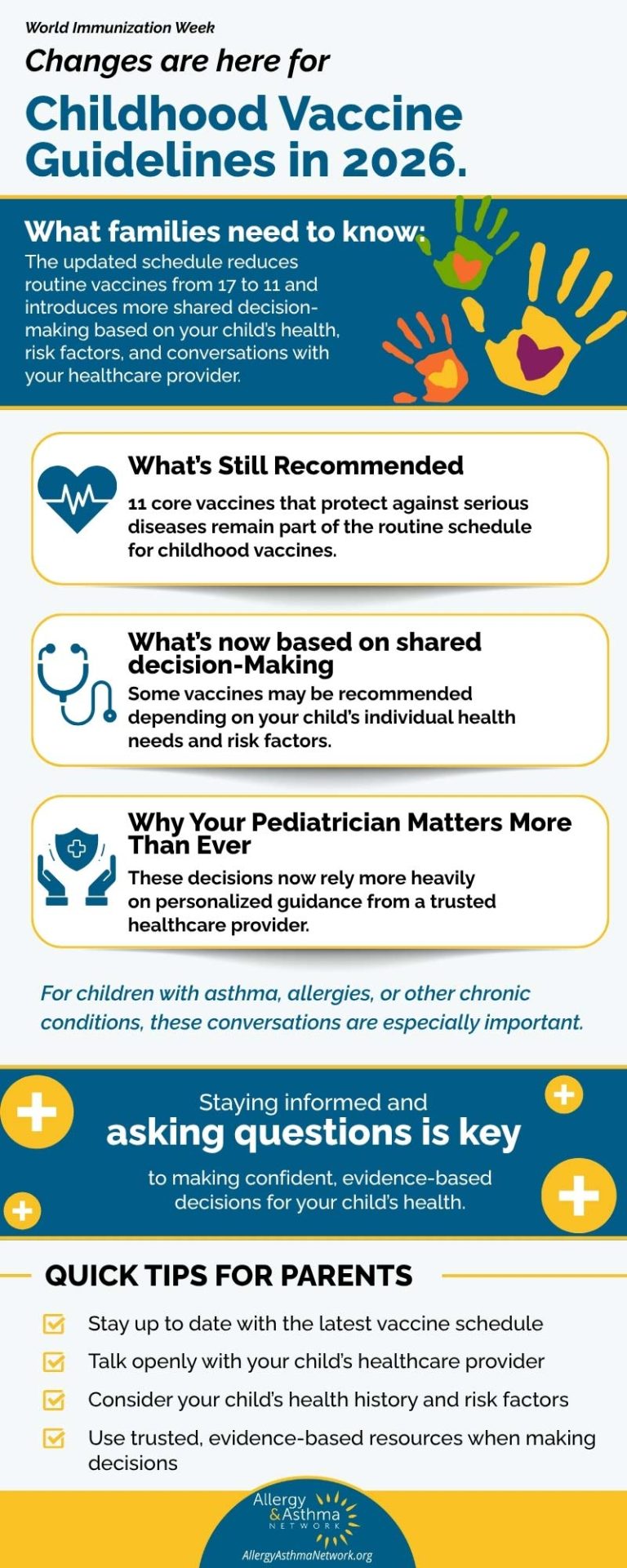
In January 2026, the U.S. Department of Health and Human Services (HHS) and the U.S. Centers for Disease Control and Prevention (CDC) announced major changes to the childhood immunization schedule, reducing the number of recommended vaccines from 17 to 11.
Current vaccine recommendations
CDC now groups vaccines into three categories (for vaccine preventable diseases):
1. All children
CDC continues to recommend childhood vaccines against 11 diseases. These are measles, mumps, rubella, polio, pneumonia, pertussis (whooping cough), chickenpox, diphtheria, Hib, HPV and tetanus.
2. High-risk children
These vaccines are for children with health problems or special risks. They are: respiratory syncytial virus (RSV) for babies whose mothers did not receive the maternal RSV vaccine, and dengue.
Vaccines recommended for children with health problems or special risks also include Hepatitis A, Hepatitis B and meningitis. However, for children with no health problems or special risks, parents should discuss these vaccines with their child’s doctor as part of shared clinical decision-making.
3. Shared Clinical Decision-Making
Shared clinical decision-making is an approach in which doctors and parents work together to make vaccine decisions. It applies to vaccines for influenza (the flu), COVID-19 and rotavirus. It also applies to Hepatitis A, Hepatitis B and meningitis vaccines for children who have no health problems or special risks.
For people with asthma, allergies and certain high-risk groups, the following vaccines can help protect against illness or severe illness:
Vaccine schedules are carefully timed by healthcare professionals to help protect kids while their bodies are still growing and are most vulnerable to infection. Vaccines work by helping to build a strong immune system.
The schedules are based on decades of evidence-based research. They have helped keep children healthy against some of the deadliest diseases and saved lives. The practice has also helped save families – and the healthcare system – money by preventing illness.
Article continues below infographic
Why did the vaccine schedule change?
The new vaccine policy is based on immunization guidelines of some other countries. President Trump issued a memorandum to direct this new policy. The United States now follows a vaccine schedule modeled after Denmark and 20 other “peer developed” countries (e.g., UK, Canada, Australia, Japan and Germany). As a result, the schedule now recommends fewer vaccines.
The decision has caused concern among doctors, public health professionals and vaccine experts in the United States. Modeling a schedule for American children based on what worked in other countries is not an apt comparison. It does not reflect the diverse population and health status of U.S. children.
This is why Allergy & Asthma Network advocates for greater diversity in research studies and clinical trials. Vaccination guidelines and health advice should be rooted in scientific evidence and benefit all children.
What the new vaccine schedule means for families
According to HHS, most vaccines are still covered by insurance. Parents will not have to pay out of pocket for many shots. Access remains strong. But now, families may need to talk more with their child’s doctor and make more choices themselves.
These abrupt changes may be confusing and stressful for parents. Shared clinical decision making empowers patients to make informed choices with their providers in their healthcare journeys. However, mandating a set of vaccines does make it easier for parents to streamline those decisions.
Now, parents may feel greater responsibility for healthcare decisions. Hesitation around conflicting messages can reduce confidence and uptake of vaccines. That can lead to fewer children getting protected. Some may get very sick.
Next steps for childhood vaccines
The American Academy of Pediatrics (AAP) says parents should work closely with their child’s pediatrician and follow trusted advice from healthcare providers. Parents who wish to vaccinate their children for the previously recommended 17 vaccines, may still do so.
Parents should also use reliable sources on latest vaccine updates from the CDC and the AAP. If your child has asthma, allergies or another immune-related condition, be sure to discuss vaccines with the pediatrician so you can make the best decision for your child’s health. If you need help finding a vaccine near you, visit this Vaccine Locator for more information.
Reviewed by:
William E. Berger, MD, FACAAI, is a board-certified allergist and immunologist who serves as a media spokesperson and Chair of the Medical Advisory Council for Allergy & Asthma Network. He is a Distinguished Fellow and Past President (2002-03) of the American College of Allergy, Asthma & Immunology (ACAAI).


