
Finding Beauty Beyond the Hives: Emmeka’s Story
Published: October 8, 2025 Revised: October 10th, 2025
As a Black woman and natural hair and beauty creator, Emmeka Hawkins’s experience of living with chronic spontaneous urticaria (CSU) has meant facing unpredictable hives, exhausting flares, and doctors who don’t always seem to take her symptoms seriously. Her journey to a diagnosis was long, frustrating, and often dismissive. Yet she has learned to manage her condition without letting it define her life.
Emmeka brings a unique perspective to CSU. She has had to rethink her routines, adjust the products she uses, and advocate for herself in medical spaces where her hives aren’t always visible on her skin. Through it all, she continues to live fully, stay creative, and share her story so others know they are not alone.

When did your hives first appear, and did doctors take your concerns seriously?
I first noticed my hives in 2020. I was doing my nightly routine of taking my shower and getting ready to wind down for the night. Right after I took my shower, I noticed that my back started to itch really, really badly. And I assumed that either the water was too hot or the products that I was using that night, which are the same products that I’ve used every other night, but for some reason that night, may have caused some type of allergic reaction.
I didn’t really know what was happening and I couldn’t see my back. I had my partner look and he said that it was red, like random welts on my back. So I had him put itch cream on there. That worked for all 15 minutes and then I had him do it again until I was able to finally get to sleep.
My story is a little bit more unique because I couldn’t see a doctor right away during the COVID-19 pandemic. I called the doctor and a lot of times, if you didn’t have any underlying conditions or if you didn’t have COVID, they didn’t really want you inside the office. I couldn’t see a doctor until a year and a half later after my diagnosis. When I did talk to someone over the phone, they didn’t give me too many answers because they couldn’t see what was really going on with me. At the time I spoke with them, I didn’t have any hives.
What was your diagnosis process like?
I would tell my doctor about my experiences, and she told me to let her know if it still continues. Once I saw her again, I was able to bring pictures and everything and she was able to let me know that this looks like chronic urticaria. She let me know that it should go away within two years.
But of course I had already been dealing with symptoms for a year and a half. So when she told me that it would be just 24 more months and I should be in the clear, this gave me a little bit of hope. But, deep down, I knew that wasn’t the case. And I did not get any other answers, other recommendations or other options. It kind of felt like I was being disregarded in a way.
What was your experience with specialists?
When I was referred to a specialist, it was not for the hives. It was for something else that I was also dealing with simultaneously, that I thought may have been tied with the hives. That made me think the hives were an allergic reaction. I received the allergy test and it turned out I was not allergic to anything.
When I did get the test, that was probably the worst thing that I have ever experienced because you can’t take antihistamines for 5 days before you get tested. I didn’t realize how much the antihistamines were helping me and my hives.
It just felt like my entire body was on fire. I couldn’t really walk around. I couldn’t really shower. I couldn’t really move in my bed without this intense itch.
Since I learned I’m not allergic to anything, I wanted to know what’s next and asked the doctor if there are any alternatives to just taking antihistamines every day. Once again, I felt dismissed. I remember the allergist saying to me, you can either take the antihistamine or you’re itchy. It’s your choice
How does CSU affect your daily life?
Throughout my day, and my daily life, I know I deal with a lot of anxiety with, ‘Are my hives going to show up today? If I take my antihistamine, is it going to help today?’ Sometimes, being a woman, I notice that it doesn’t help, depending on what time of the month it is. I noticed that there are different times of the month when if I know that my hormones are unregulated, then my hives will be worse.
As a person of color, have you experienced CSU differently?
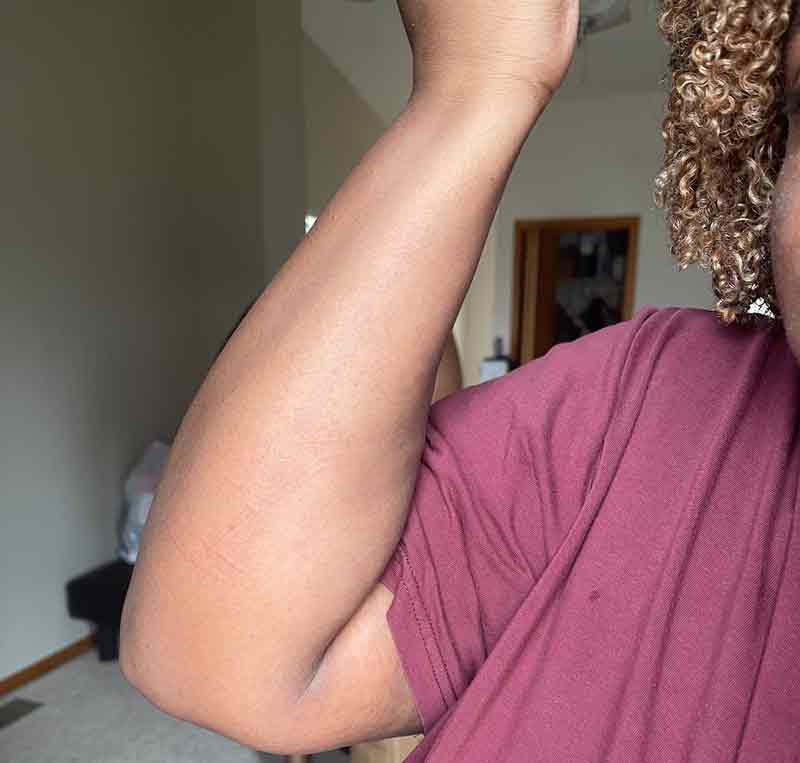
I don’t feel like this is that much different than, you know, anyone else living with CSU. I know that when I do have hives, they don’t show up as easily on my skin. Sometimes if I am talking to someone about my CSU and they want to see the hives, I can’t always show them. But I feel like that’s also common with other CSU patients because you don’t always have hives all the time.
How do you manage your social life while living with CSU?
I try not to let it affect me much, as I enjoy being outside. I like to do things. I like to have fun. So if I need to pop around the corner and take an antihistamine quickly, I’ll do it, and then I’ll be fine. And even if I’m having a day where I’m not really feeling too well, and I still have this itch, I just ignore it. I want to be able to enjoy my life and not feel like I can’t enjoy the things I love to do because I don’t feel well.
What kind of support do you receive from your community?
I’m open and honest with them about anything that happens. My friends, my family, and my partner are all on the same page now. With me having hives and having to take antihistamines, my partner keeps them in his backpack. He takes everything everywhere just in case I forget, which I do sometimes. My friends are all supportive. If I’m outside and I’m like, ‘Oh, I’m feeling itchy,’ they’ll tell me, ‘Oh, Walgreens is open,’ if I don’t have medication.
How has CSU influenced your identity as a beauty and natural hair creator?
For my hair and finding products that really work for me, I had to eliminate heavy oils and butters, among other things. I thought that it was going to affect me more than it has. However, it has also had the opposite effect. Using lighter ingredients and cleaner ingredients makes my hair feel better, and it makes it healthier.
Everyone is different, but I’ve had such a positive experience with using these products that it almost makes me think, ‘This is how it was supposed to be in the first place for me.’ Going with cleaner ingredients, it makes me more in tune and I notice things more when something is not right.
What advice would you give to someone who feels culturally attached to certain beauty or hair products?
I think it’s really hard for people to get out of their norm. If it’s a beauty or hair product that you grew up on, you expect it to work for you forever. You know, it’s something from your mom and your grandmother, and things of that sort. So, it’s hard for some people to reach the point where they’re open to trying something new.
It takes a little bit more getting used to. Your hair is not going to automatically be like, ‘Okay, we love this!’ It’s kind of like detox – and then your hair and your skin will get more accustomed to the change.
What advice would you share with someone newly diagnosed with CSU, especially a person of color?
I want them to know that CSU does not have to take over their entire life. It can only do as much as you let it. And, yes, of course, CSU is something that will take time. Being patient with your body is the most important thing because when you are diagnosed with CSU, you don’t know exactly how it’s going to affect you.
Once you’ve gone through the first couple months and noticed patterns, you can use those patterns to your advantage to continue doing the things you love. It might feel a little different because you may still feel a bit uncomfortable, but don’t let it completely take over your life. If you do, you won’t have the opportunity to live life to the fullest. You’re kind of letting it hold you back.
What do you wish healthcare providers understood about caring for patients with CSU?
I would really explain to them how it affects me day-to-day. If I had done this, maybe I could have gotten a little bit more of a conversation and more treatment options. I wish I had told the doctor more because she couldn’t see my hives on me and I was only able to show her pictures. So I don’t think she really got the full story of how it was really impacting me.
Doctors only know as much as you tell them. So tell them everything.


