
How Dupilumab Reduces Mucus Build-Up in Asthma
In a special episode, the Allergy, Asthma & Immunology Innovations podcast partners with the American Thoracic Society (ATS) for The Itch Review, an examination of important research in allergy and asthma care. For this episode, we talk about treating mucus with dupilumab (brand name Dupixent®), a biologic medicine already used for asthma, eczema, and nasal polyps.
Our hosts, Payel Gupta, MD, and Kortney, are joined by Michael Blaiss, MD, to discuss a new study published online in the American Journal of Respiratory and Critical Care Medicine called “Effect of Dupilumab on Mucus Burden in Patients with Moderate-to-Severe Asthma.”
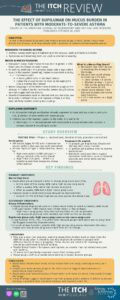
This study, called VESTIGE, looked at whether dupilumab could lower mucus plugs. These are thick, sticky mucus that can block the airways and make it hard to breathe for people with asthma.
You can listen to the podcast on ItchPodcast.com or download it for listening anytime, anywhere, at:
This podcast is for informational purposes only and does not substitute professional medical advice. Any mention of brands is also informational and not an endorsement. Always consult with your healthcare provider for any medical questions or concerns.
A special collaboration with the American Thoracic Society.
What are mucus plugs, and why do they matter?
In healthy lungs, thin mucus helps trap dust and germs so the body can clear them out. In asthma, this mucus can become thick and sticky, blocking the airways. These mucus plugs make it hard for air to move in and out of the lungs. This can make breathing difficult and asthma harder to control.
Usual asthma medicines, like inhalers and oral corticosteroids, help calm swelling and open the airways, but they don’t always clear out the thick mucus.
What we cover in this podcast about the VESTIGE trial
We unpack the VESTIGE trial and discuss the role of mucus in healthy people with asthma:
- Mucus makes asthma harder to control: Thick, sticky mucus can block parts of the lungs and make it hard to take deep breaths.
- How the study worked: Adults with asthma received either dupilumab or a placebo (fake medicine) every two weeks, along with their regular treatments. Lung scans were done at the start, after 4 weeks, and again at 24 weeks to see how much mucus was in the airways.
- Dupilumab lowered mucus: After 24 weeks, people taking dupilumab had fewer mucus plugs on their lung scans.
- Biggest improvements in people with more mucus: Those who started with higher mucus levels saw the most improvement.
- Better breathing and control: Clearing mucus plugs helped people breathe easier and may lower the risk of asthma flare-ups.
Timestamps for our podcast about the VESTIGE trial
01:21 – What is mucus and mucus plugging
05:42 – Asthma basics
09:42 – Mucus in the lungs
10:57 – How dupilumab works
14:11 – VESTIGE trial design
17:48 – Who qualified for the study?
22:53 – Patients in the study
25:46 – Study endpoints
28:10 – Study results
33:53 – Study limitations
36:06 – Key takeaways
Resources about asthma
- What is Asthma?
- Asthma Medication and Treatment
- What is Dupixent (dupilumab)?
- What is Type 2 Inflammation?
- Podcast archive: Understanding Type 2 Inflammation


